

Meredith Buono and Josiah Morris
Investigating the conformational changes caused by mutations of the deoR repressor protein in domesticated strains of bacteria using 19F NMR spectroscopy
Abstract:
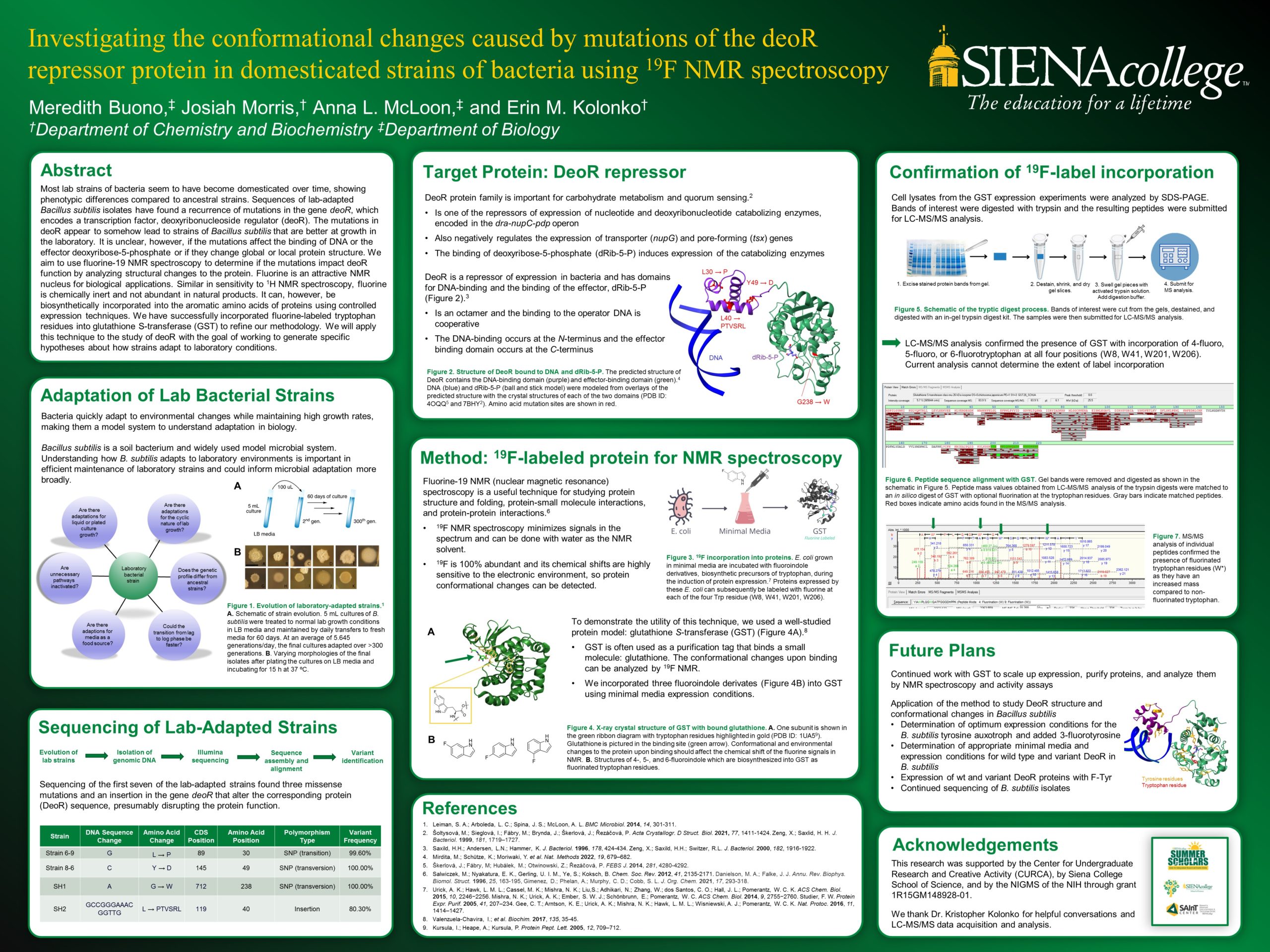
Most lab strains of bacteria seem to have become domesticated over time, showing phenotypic differences compared to ancestral strains. Sequences of lab-adapted Bacillus subtilis isolates have found a recurrence of mutations in the gene deoR, which encodes a transcription factor, deoxyribonucleoside regulator or deoR. The mutations in deoR appear to somehow lead to strains of Bacillus subtilis that are better at growth in the laboratory. It is unclear, however, if the mutations affect the binding of DNA or the effector deoxyribose-5-phosphate or if they change global or local protein structure. We aim to use fluorine-19 NMR spectroscopy to determine if the mutations impact deoR function by analyzing structural changes to the protein. Fluorine is an attractive NMR nucleus for biological applications. Similar in sensitivity to 1H NMR spectroscopy, fluorine is chemically inert and not abundant in natural products. It can, however, be biosynthetically incorporated into the aromatic amino acids of proteins using controlled expression techniques. We have successfully incorporated fluorine-labeled tryptophan residues into glutathione S-transferase (GST) to refine our methodology. We will apply this technique to the study of deoR with the goal of working to generate specific hypotheses about how strains adapt to laboratory conditions.
Title
Investigating the conformational changes caused by mutations of the deoR repressor protein in domesticated strains of bacteria using 19F NMR spectroscopy
Faculty Advisor
Dr. Erin Kolonko
Course
Protein Biochemistry Research- CHEM 499 - 04
Presentation Type
Poster
Location
Table 95