

Molly Mason
Innate Immunity: Analysis of Parasitoid Wasp Venom Transcriptome
Abstract:
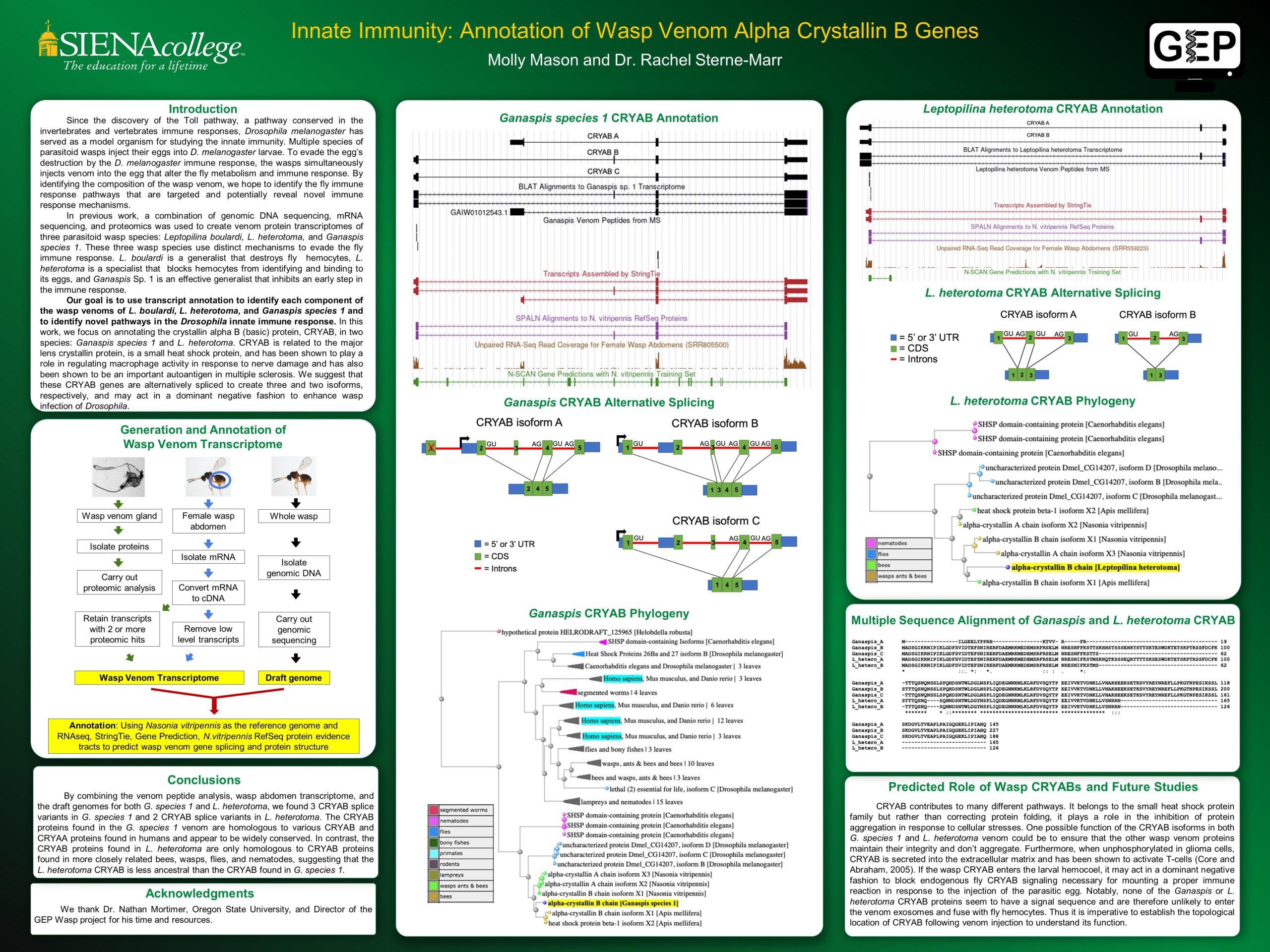
Since the discovery of the Toll pathway, an important innate immune pathway conserved in both invertebrates and mammals, Drosophila melanogaster has served as a model organism for studying the innate immune response. There are multiple species of parasitoid wasps that inject their eggs into D. melanogaster larvae and to evade the egg’s destruction by the D. melanogaster immune response, the wasps inject venom into the larvae alongside the egg. By identifying the protein composition of the parasitoid wasp venom, we can potentially identify the D. melanogaster proteins the wasp venom targets, thus identifying essential pathways for the D. melanogaster immune response. In this study, a combination of genomic DNA, RNA sequencing, and proteomics was used to create a venom protein transcriptome of three species of parasitoid wasps: Leptopilina boulardi, L. heterotoma, and a species that has been designated Ganaspis species 1 for the purpose of this study. Through these transcriptomes, we hope to identify and characterize the proteins in the venoms of L. boulardi, L. heterotoma, and Ganaspis species 1 venom to identify potential pathways in the D. melanogaster innate immune response. In this poster, we will focus on annotating and understanding six venom proteins found in Ganaspis species 1 and L. heterotoma with homology to CRYAB. CRYAB is a small heat shock protein involved and has been shown to play a role in regulating macrophage activity in response to nerve damage and has also been shown to be one of the most important autoantigens in multiple sclerosis.
Title
Innate Immunity: Analysis of Parasitoid Wasp Venom Transcriptome
Faculty Advisor
Dr. Rachel Sterne-Marr
Course
BIOL499
Presentation Type
Poster
Location
Table 76