

Trinity Cooper and Riley Dallos
Fairness or Fortune: Which would you choose
Abstract:
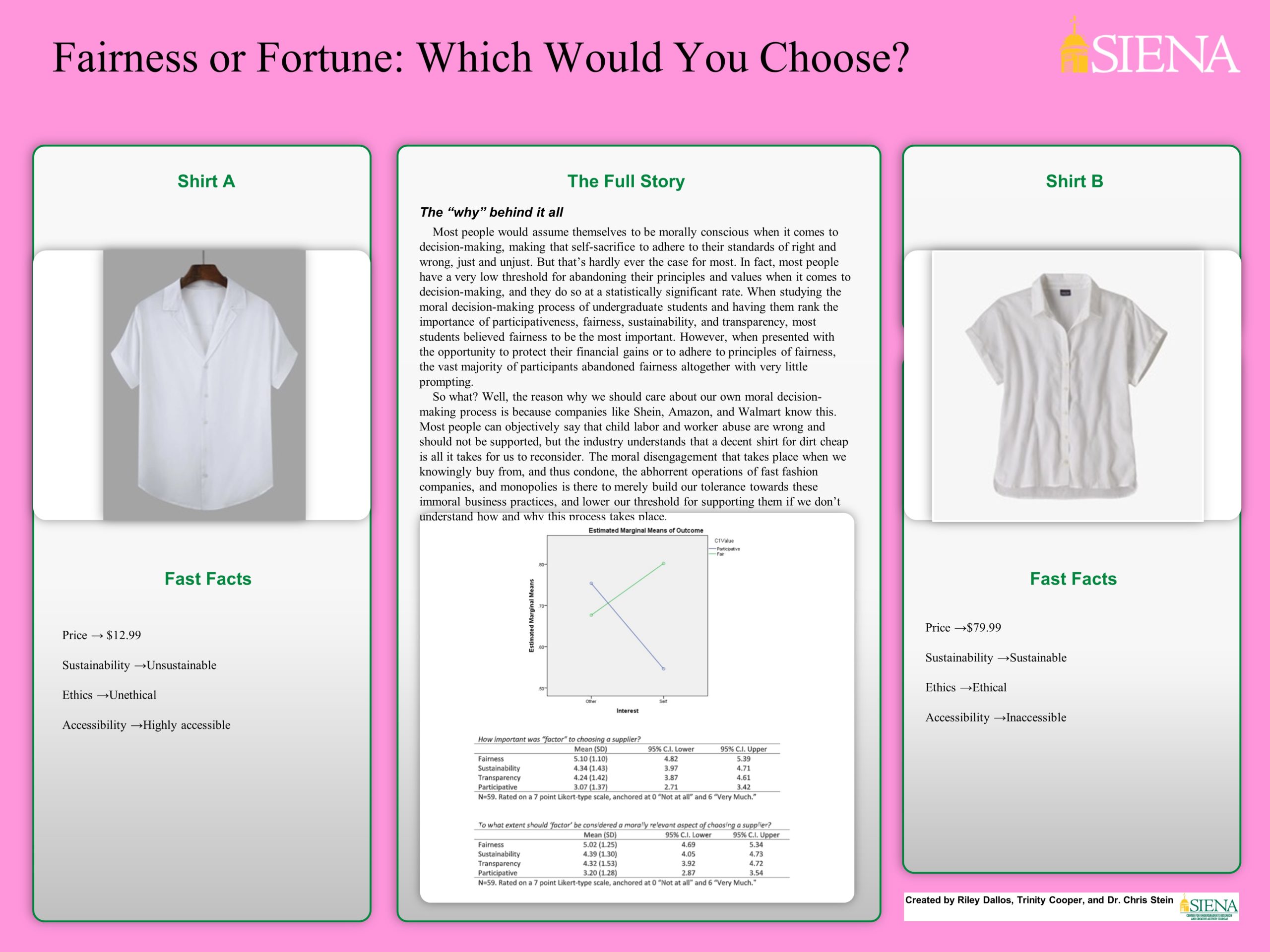
Most people would assume themselves to be morally conscious when it comes to decision-making, making that self-sacrifice to adhere to their standards of right and wrong, just and unjust. But that’s hardly ever the case for most. In fact, most people have a very low threshold for abandoning their principles and values when it comes to decision-making, and they do so at a statistically significant rate. When studying the moral decision-making process of undergraduate students and having them rank the importance of participativeness, fairness, sustainability, and transparency, most students believed fairness to be the most important. However, when presented with the opportunity to protect their financial gains or to adhere to principles of fairness, the vast majority of participants abandoned fairness altogether with very little prompting. So what? Well, the reason why we should care about our own moral decision-making process is because companies like Shein, Amazon, and Walmart know this. Most people can objectively say that child labor and worker abuse are wrong and should not be supported, but the industry understands that a decent shirt for dirt cheap is all it takes for us to reconsider. The moral disengagement that takes place when we knowingly buy from, and thus condone, the abhorrent operations of fast fashion companies, and monopolies is there to merely build our tolerance towards these immoral business practices, and lower our threshold for supporting them if we don’t understand how and why this process takes place.
Title
Fairness or Fortune: Which would you choose
Faculty Advisor
Dr. Christopher Stein
Course
MGMT 499
Presentation Type
Poster
Location
Table 7