

Danial Rehman and Joseph Celeste
Behavioral Responses of Feather-Feeding Lice to Preen Oil
Abstract:
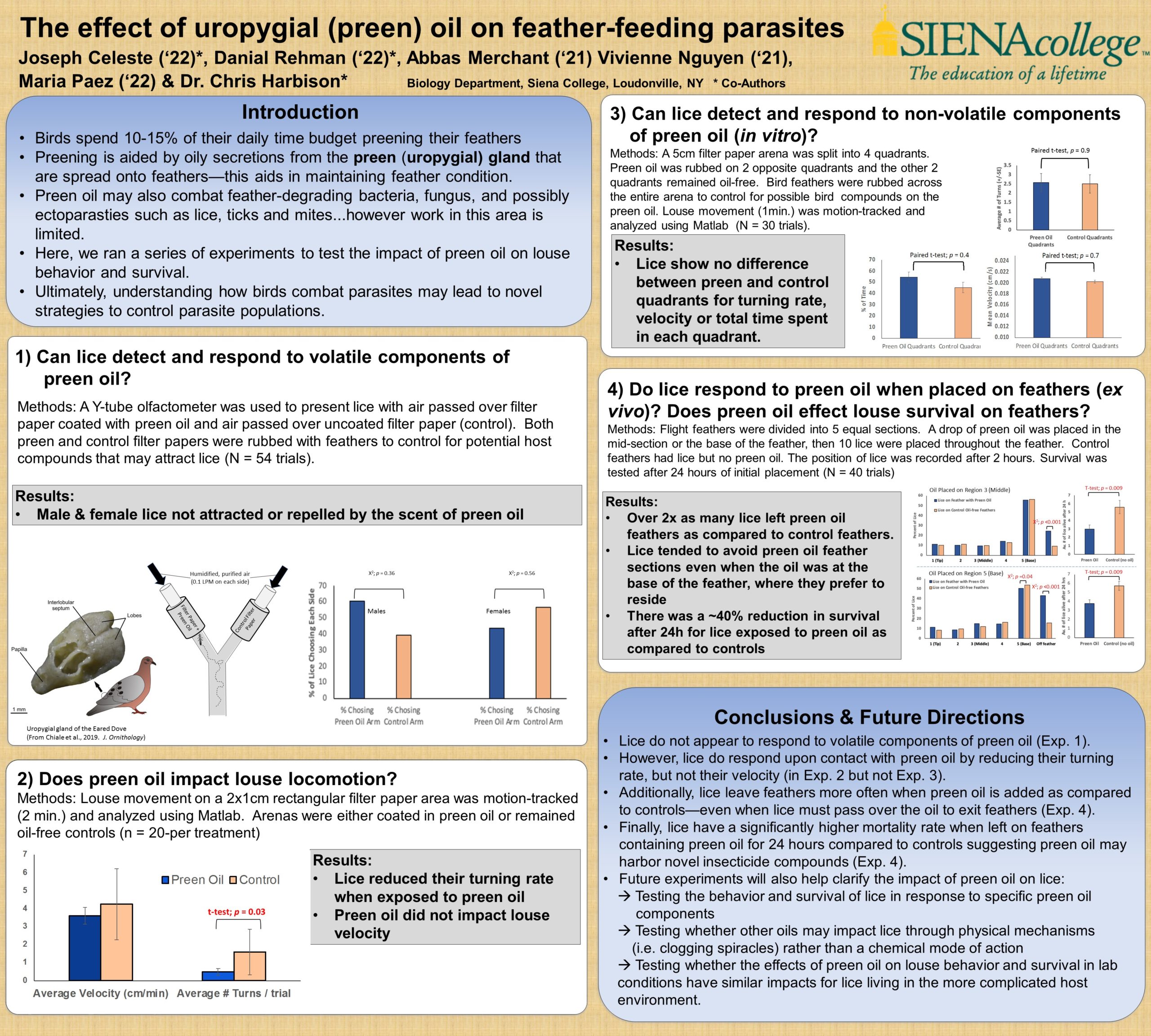
Lice are well-known pests of mammals and birds and cause economic losses for livestock and poultry producers. Understanding how hosts combat these parasites may lead to novel parasite control strategies. Birds possess a uropygial (preen) gland that produces a mix of waxes and oils that are anointed onto feathers with the bill while preening. Preen oil helps feathers withstand physical wear, however researchers have also proposed that components of preen oil may also act as a chemical defense against parasites. Here, we test the behavioral responses of feather-feeding lice to preen oil. In a series of experiments, we show that lice reduce their turning rate when walking over preen oil and move towards volatile compounds emitted by preen oil. Furthermore, lice placed on feathers with preen oil are more likely to remain near the oil as compared to lice on feathers without oil that tend to move towards the base of the feather. These results suggest lice are not harmed by preen oil and may actually be attracted to components of preen oil. However, preliminary new results testing the survivability of lice on feathers with preen oil show that lice favor being off of the preen oil feather.
Title
Behavioral Responses of Feather-Feeding Lice to Preen Oil
Faculty Advisor
Dr. Chris Harbison
Course
BIO499
Presentation Type
Poster
Location
Table 71