

Asavari Gowda, Sarah Ahmed-Weidman, Cadyann Douglas and Josh Matteson
Exercise or diet reduce negative chronic social stress consequences in female mice
Abstract:
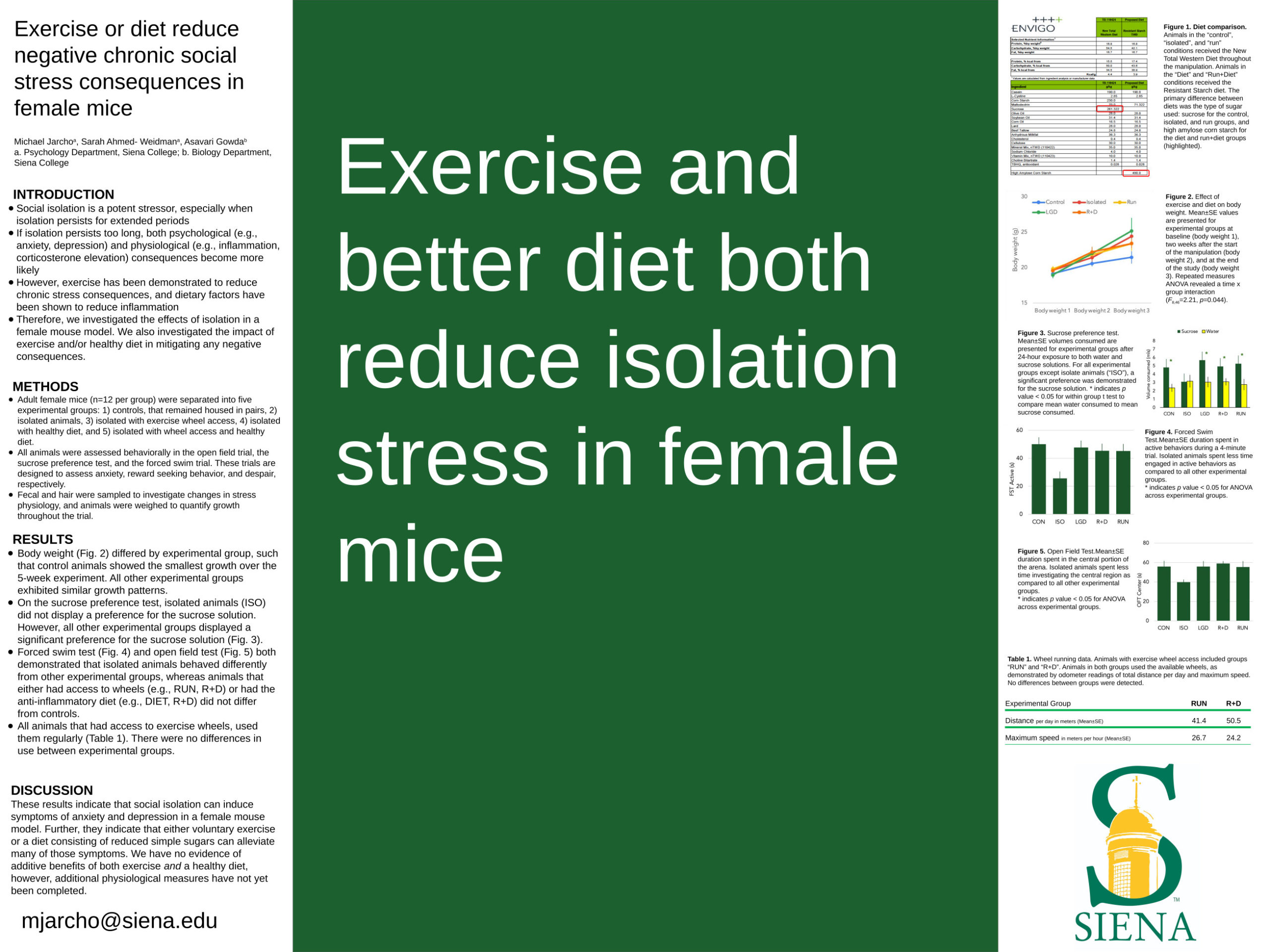
We investigated the effects of isolation in a female mouse model and the impact of exercise and/or healthy diet in mitigating any negative consequences. Adult female mice (n=12 per group) were separated into five experimental groups: 1) controls, that remained housed in pairs, 2) isolated animals, 3) isolated with exercise wheel access, 4) isolated with healthy diet, and 5) isolated with wheel access and healthy diet. All animals were assessed behaviorally in the open field trial, the sucrose preference test, and the forced swim trial. These trials are designed to assess anxiety, reward seeking behavior, and despair, respectively. Fecal and hair were sampled to investigate changes in stress physiology, and animals were weighed to quantify growth throughout the trial. Significant result include that on the sucrose preference test, isolated animals (ISO) did not display a preference for the sucrose solution. However, all other experimental groups displayed a significant preference for the sucrose solution (Fig. 3). Forced swim test (Fig. 4) and open field test (Fig. 5) both demonstrated that isolated animals behaved differently from other experimental groups, whereas animals that either had access to wheels (e.g., RUN, R+D) or had the anti-inflammatory diet (e.g., DIET, R+D) did not differ from controls. These results indicate that social isolation can induce symptoms of anxiety and depression in a female mouse model while voluntary exercise or a reduced sugar diet can alleviate many of those symptoms.
Title
Exercise or diet reduce negative chronic social stress consequences in female mice
Faculty Advisor
Dr. Michael Jarcho
Course
Independent Study in Psychology
Presentation Type
Poster & Presentation
Location
Table 29