

Jessica Shine and Righlee Thibault
Social Connectedness & Trauma: The Role of Social Media
Abstract:
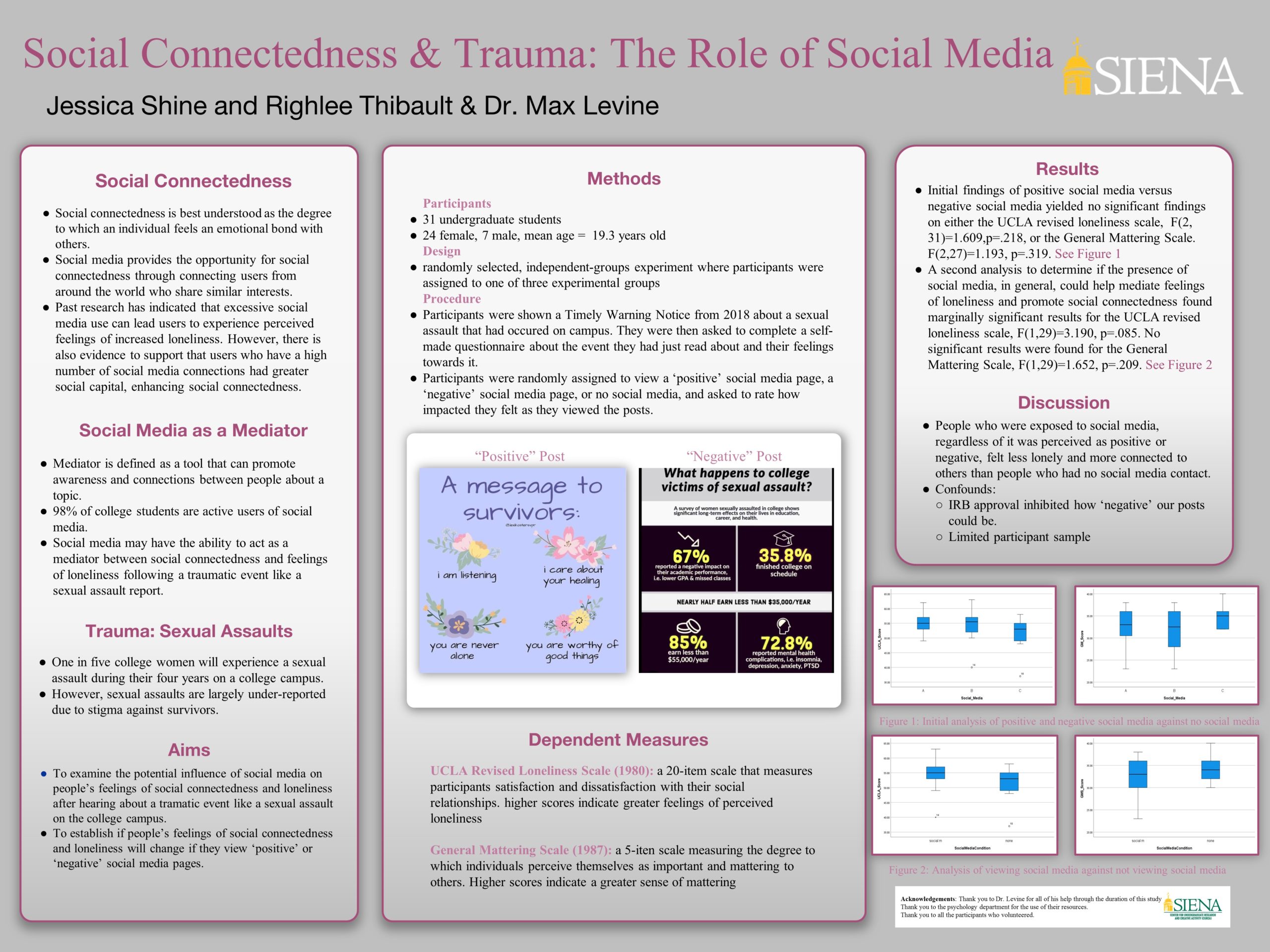
Social media is becoming an increasingly influential part of our lives; it has the power to connect and divide people. It may even have the ability to influence social connectedness after experiencing a traumatic event. College students are far too familiar with Timely Warning Notices of sexual assaults that appear in our email inboxes or on the doors of every academic building. This study aimed at understanding what role social media can potentially play in connecting or diving people after experiencing a traumatic event like sexual assault. Participants in this study were presented with a Timely Warning Notice from 2018, eliminating the possibility that any participant could have been the victim in question. Participants were then presented with one of three conditions: social media that advocates for sexual assault awareness; social media that criticizes sexual assault survivors; or no social media. To assess feelings of social connectedness, participants were then asked to complete the UCLA Revised Loneliness Scale and the General Mattering Scale. We are interested in investigating the potential power of social media, and if any gender differences exist within this domain.
Title
Social Connectedness & Trauma: The Role of Social Media
Faculty Advisor
Dr. Max Levine
Course
Research Methods II (PSYC 400)
Presentation Type
Poster
Location
Table 23